
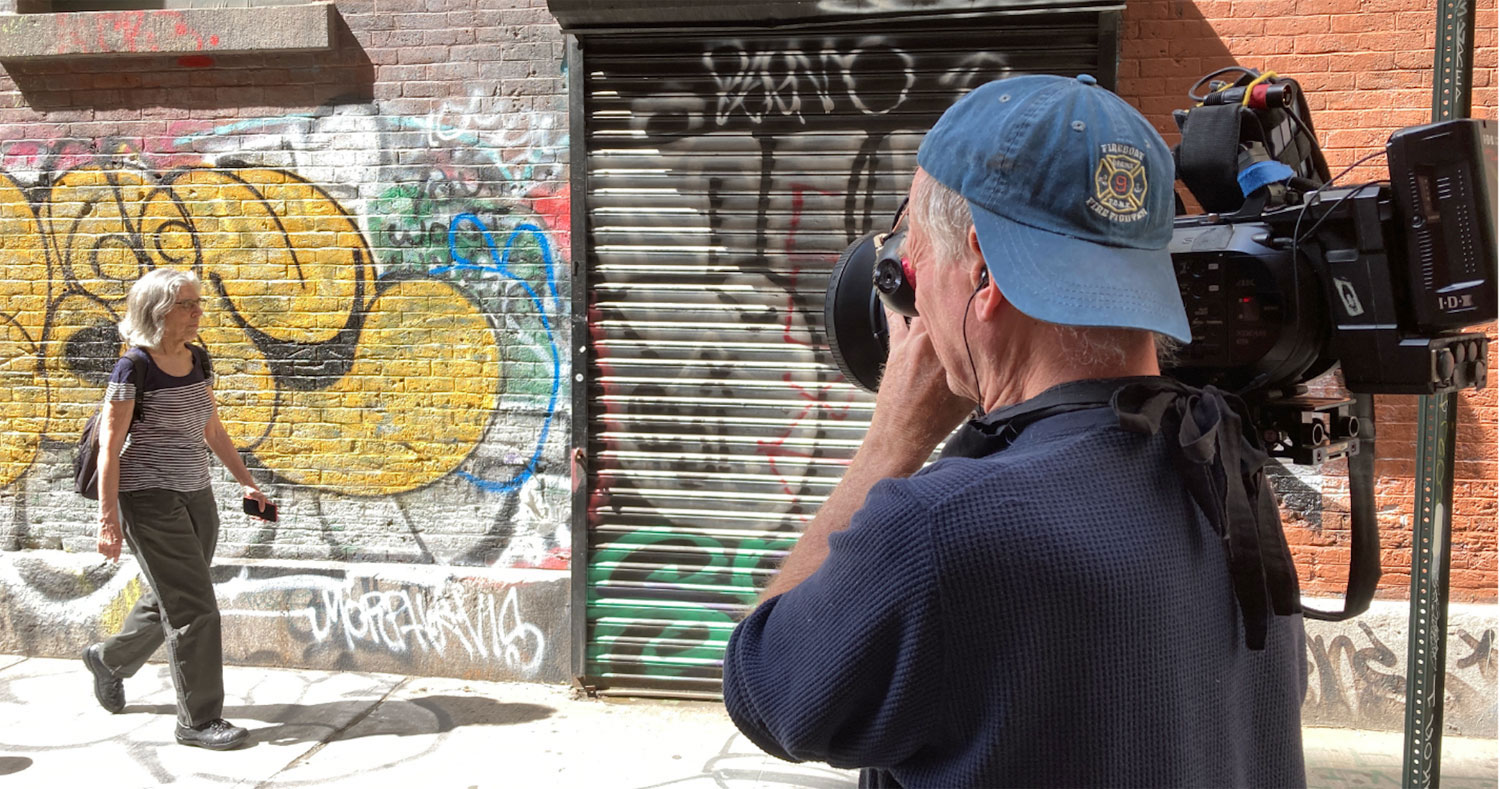
There are surprisingly few documentary films about SoHo considering how influential the neighborhood has been on so many fronts—art, architecture, and artist housing to name only a few. It is a place unlike any other, with an equally unique history.
On the big screen, SoHo was famously a main character in Martin Scorsese’s After Hours, and was a backdrop in other Hollywood films such as Paul Mazursky’s An Unmarried Woman and Woody Allen’s Hannah and Her Sisters. But there are almost no films that elevate SoHo from interesting location to narrative force, that show us that SoHo is a real place, rather than an idea based on a mythical past.
Filmmaker Alice Arnold and sociologist Sharon Zukin have teamed up to show us a SoHo that is, yes, steeped in history, and is also a vital place in New York City’s here and now. “SoHo in Flux,” their documentary film due out in 2027, examines how “the cultural capital of contemporary art and cast-iron architecture turned into financial capital, leading to high property values, luxury lofts and stores, and eventually a contentious rezoning in 2021.”
How does one go about capturing SoHo on film, its past and present, in all its grit and glory? Alice and Sharon of course interviewed a wide range of SoHo stakeholders. Yet the film is at its core about place and is told visually. They spent the last couple of years filming on SoHo streets and in lofts, studios, offices, and rooftops. They even employed a drone. I recently sat down with them to ask them how they conveyed the specificity of SoHo—its landscape, history, and atmosphere—to a general audience, the majority of whom has only the vaguest idea of what SoHo is, of what SoHo means.
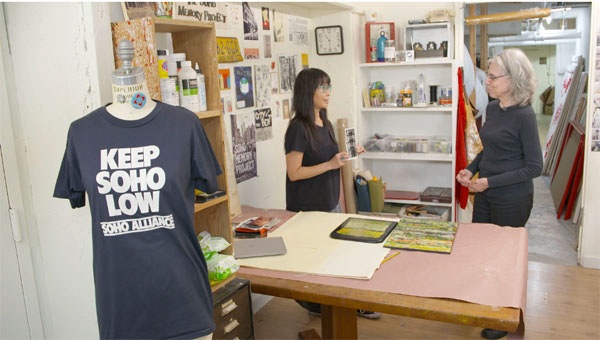
Q: Please introduce yourselves
Sharon:
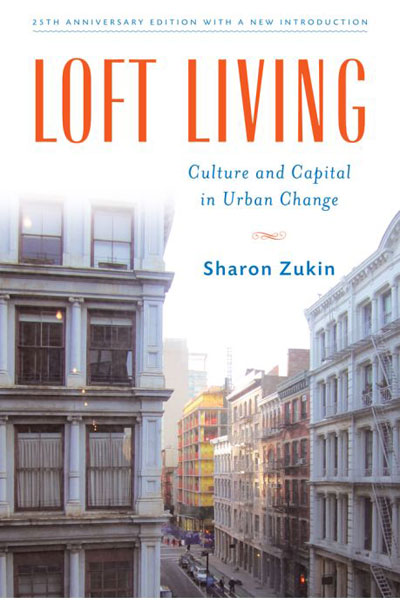
I’m a sociologist who often writes about New York. My first book about the city, Loft Living (1982), traces the surprising rise of the real estate market in residential lofts in the 1970s and 1980s, and SoHo was at the center of that development. Alice is a filmmaker and photographer whose work documents the city’s built environment. Her documentary film To Be Seen (2006) looks at street art and public space, and SoHo, which was a hub of street art in the ’90s and early 2000s.
Q: Please introduce your film project
Sharon:
“SoHo in Flux” tells a story about the eternal battle between art and real estate in New York at a time when disinvestment in traditional manufacturing and growing support for new art and music put SoHo on the cusp of urban reinvention. After a decade of avant-garde innovation and loft renovation, the cultural capital of contemporary art and cast-iron architecture turned into financial capital, leading to high property values, luxury lofts and stores, and eventually a contentious rezoning in 2021. But the film project began with a different story.
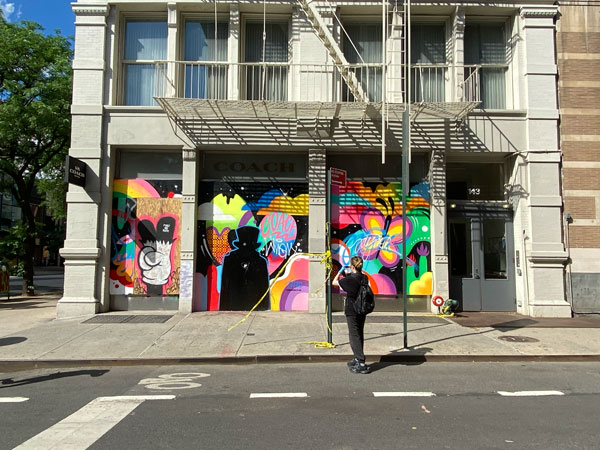
In October 2020, my friend Micki McGee, a longtime South Village resident, invited me to come to SoHo to see the murals that had been painted on plywood panels placed in store windows after the nights of looting that followed the murder of George Floyd and Black Lives Matter demonstrations. For several months, street artists flocked to SoHo to paint messages protesting racism and police brutality and images of grief and hope. These images resonated with a city that was suffering greatly from the Covid-19 pandemic and extreme economic distress.
Walking the streets and feeling the dynamism of the street art, I was seized by the idea to make a documentary film about SoHo, so I asked Alice if she was interested in collaborating. I had written Loft Living, of course, and Alice had already spent a lot of time in SoHo to experience the murals and the scene. Much later, I was amused to learn that Alice thought we would make a 15-20 minute film, while I envisioned a full-length feature. But you would really need a 12-part series to cover all of the stories, people, and creative work that make SoHo such a special place.
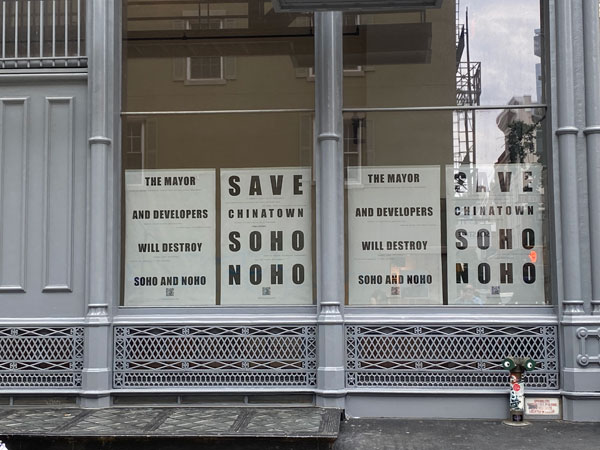
One of the key motivations for the film was the SoHo/NoHo rezoning plan, which we knew was both significant and controversial. So from the outset, the film was framed by zoning issues. SoHo’s “golden age” as an arts district began in 1971, when zoning exclusively for light manufacturing was changed to permit artists’ live-work lofts. Fifty years later, in 2021, a second rezoning eliminated the special conditions for artists’ lofts and encouraged new residential and commercial development.
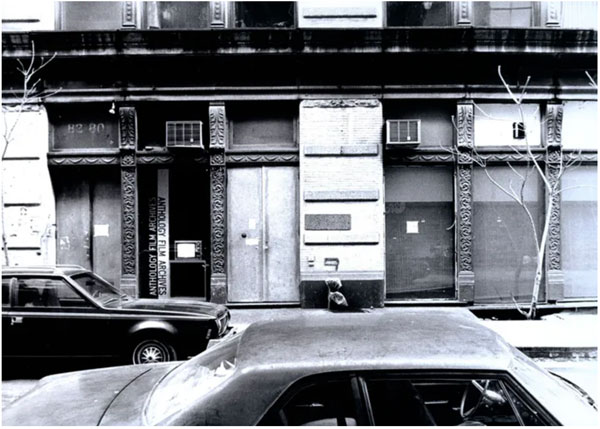
It was hard to choose just one thread to follow, but we decided to center the narrative of “SoHo in Flux” on the history of a single building, “Fluxhouse Number 2,” at 80 Wooster Street. The film begins in 1968 with the Fluxist founder George Maciunas’s crazy dream of buying old industrial buildings to create housing cooperatives for artists. We show how this building has changed since then, and then we spread out to tell the important stories of SoHo’s feminist artists, artists of color, and transition from an arts district to a center of shopping and entertainment. We join artists in their lofts, art dealers in their galleries, and activists, advocates, and city planners on the streets. We end with the real estate developer and architect who are creating SoHo’s first new residential project to include affordable apartments, at Canal Street and Broadway, as they share their thoughts about building in a historic district and in a changing city.
Q: How does SoHo function within your documentary—as a backdrop, a character, or something else entirely? Do you see the neighborhood as an active narrative force or simply a location?
Sharon:
It’s complicated! SoHo is both a backdrop and an actor. It is a place, a community (or a collage of communities), and an economic ecosystem. Like other neighborhoods, SoHo has special characteristics that are determined by laws—in SoHo’s case, zoning laws and historic district designations, and also tax credits for investments in historic buildings. All that shapes the look and feel of the place. SoHo is also shaped by the kinds of people who live here, the businesses and organizations that influence street life and public aesthetics, and, of course, by property values and rents. In short, SoHo is a very complex place.
Q: How do you approach portraying the ‘real’ SoHo? What decisions do you need to make when representing a layered, often mythologized neighborhood.
Sharon:
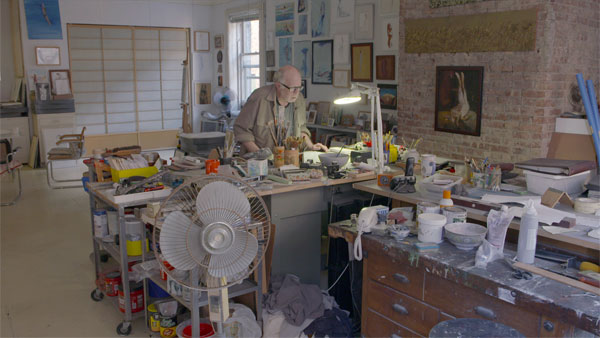
Our goal as filmmakers is to embrace SoHo’s complexity and try to portray its contradictions. The more people we talk with, the more we learn about SoHo, and the more complicated our story becomes. The problem for me is that telling a visual story is much harder than writing a book! You have less space to add quotes and points of view; you leave out more than you put in. There’s a heavier burden of selectivity, and you hope you are doing justice to your subjects without downplaying your own point of view.
Alice:
SoHo is a neatly contained neighborhood. It is bounded by four large roads (Broadway, West Broadway, Houston and Canal) and there are 7 internal streets, forming a cohesive space consisting of 21 blocks. But SoHo always seems larger than these 21 blocks and even though it is on a grid, the space itself encourages wandering and not sticking to the Cartesian plane. And of course, SoHo’s history also expands the space, metaphorically, into a different dimension.
Loft Living by Sharon Zukin (1982/1989/2014)
Q: What drew you personally to filming in/about SoHo, and how has your relationship with the neighborhood influenced your creative process?
Sharon:
I always joked about selling my book Loft Living to Hollywood, so this film, in a way, makes the dream come true. I feel lucky to be able to revisit a place that I wrote about in 1982, and to update the story of cultural capital and real estate capital that I told at that time to show the massive reinvestment and gentrification that has remade almost all of Manhattan since then. Although I have always been interested in art and have written a lot about buildings and streets, filmmaking demands different skills, and I am still trying to learn to think more visually, so viewers of our film can feel SoHo’s aura.
Alice:
I first heard about SoHo through art books and art publications, which transmitted an aura of hipness and creative energy. So, on my first visit to New York, while still at university, I made sure to walk the cobblestone streets looking at the cast-iron architecture, step into art galleries and have a drink at Fanelli’s. Later when I moved to New York, SoHo was a place that I constantly passed through, for work purposes at Paper Magazine and for hanging out at night, listening to music in small bars. In the early 2000s SoHo was a mecca for street art, which caught my imagination and led to my first film, “To Be Seen”, a documentary about street art and public space. Many of the artists in that film, such as Swoon and the Wooster Collective, posted their work in SoHo. Although the art scene had moved to Chelsea, these artists wanted to engage with both SoHo’s history and passersby.
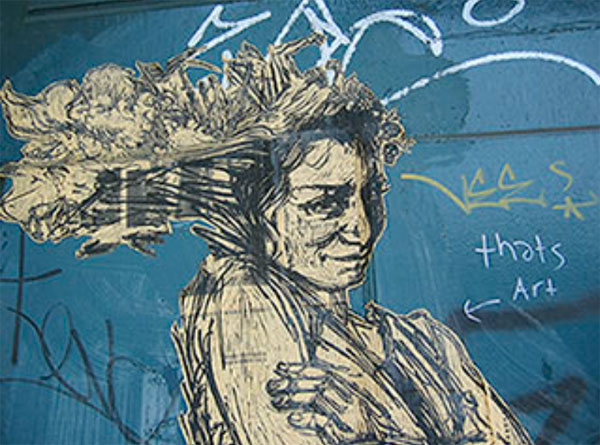
Even in the early 2000s, while I was filming “To Be Seen,” going to SoHo was like stepping into a village, a community space where traces of the city’s industrial past and memories of SoHo’s artist heyday blended amongst the cast-iron columns and eroded walls. But in the decade that followed, the 2010s, I rarely went to SoHo. Most of the street art had disappeared, replaced by advertising and the reflections of designer clothes in storefront windows. When the COVID-19 pandemic started, in Spring 2020, the city became quiet, but SoHo became again, for a few months, a golden place. Street artists came from all over the city to paint on the plywood panels that covered the storefronts and other people came to look and enjoy a moment of city life. This observation of SoHo as a cherished space in the city stuck with me throughout the filming process. So even though the luxury shops have come back in force, as have the mobs of tourists, the iron, glass, stone and brick surfaces still convey a multi-dimensional experience, where the past is layered on the present and where past and present mingle with ideas for the future.
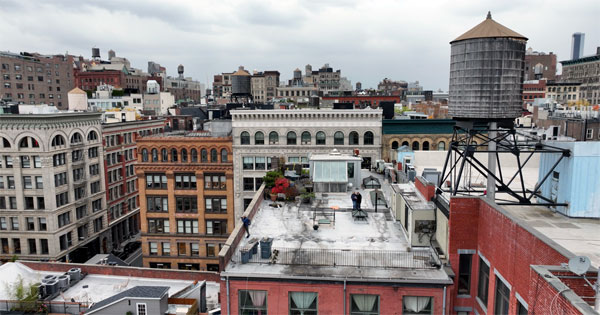
Q: What visual or sensory qualities of SoHo do you find most compelling to capture on film, and how do they help you tell your story?
Sharon:
We mostly film in daylight, when colors are bright and streets are noisy. But I like SoHo after dark, especially on the side streets, when it’s so quiet you can hear the Belgian blocks speak. Most compelling to me is the visual contrast between the brightly illuminated shops and burnished patina of SoHo’s buildings today and the almost sinister noir images of SoHo’s streets in the 1970s. As you say in the film, Yukie, your memories of SoHo change, in the 1980s, from black-and-white to Technicolor. This is what we try to show in the film.
Alice:
From a visual construction point of view, looking at SoHo through the camera’s viewfinder, the field of view is often limited by the long lines of the blocks and the density of buildings. So, this lens-based view does not fully convey such a multi-dimensional space. One strategy we used in the film to portray SoHo’s spaciousness was to weave together archival images with current imagery and to film with different time shifting techniques, from time-lapse to slower motion. Another time-based method was to film at different times of day and in different seasons. These filming techniques were used to express the changing factors of light and sound, the flowing spectacle of people and the shifting nature of the mediated images.
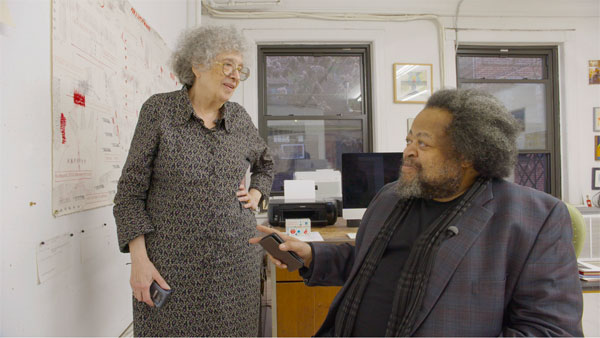
Q: Is there anything else you would like to add about making a film about SoHo?
Sharon:
We are grateful to all the people who generously shared their memories and reflections with us. The scenes in the film are both intimate and inspiring, bearing witness to a storied community and the passage of time. SoHo challenges us to think not only about the history of this place but also about the place of artists in a changing city. Not every neighborhood inspires such existential thoughts. We are also grateful to the Graham Foundation for Advanced Studies in the Fine Arts, the New York State Council on the Arts, and the PSC-CUNY Research Award Program for their support.
Alice Arnold is a documentary media maker and educator. Her film and photography projects explore the urban environment and visual culture, from street art to advertising and from sidewalks to electric signs. Her films are in the collections of university libraries and have screened at The Museum of Modern Art and other festivals. Her photographs of nightlife, hip hop culture, and portraits have been widely exhibited and published in books and magazines, including, Goldie, Timeless (Cafe Royal Books, 2022) and Hua Hsu’s Suspended in Time zine series (2025). She is a NYSCA Grantee (2026), a New York Foundation for the Arts (NYFA) Photography Fellow (2003); a Fulbright Fellow (Film, Hong Kong, 2007); and an adjunct professor at the City University of New York.
Sharon Zukin is professor emerita of sociology and of earth and environmental sciences at Brooklyn College and the CUNY Graduate Center, and writes extensively about art, architecture, and real estate in New York City. Besides Loft Living, she has written Landscapes of Power, The Cultures of Cities, Naked City: The Death and Life of Authentic Urban Places, and The Innovation Complex.
Top image: “SoHo in Flux” Director of Photography Gary Griffin filming Sharon Zukin on Jersey Street