

Grocery stores in SoHo are few and far between. This has always been the case. Back in the 1970s it was an issue perhaps of population density, not enough neighbors to be worth it. Now I’d say it’s more of an issue of rent, not enough profit margin to be worth it. The most well-known SoHo food store was Dean & DeLuca, but it wasn’t your everyday grocery. More of a special occasion grocery, it was where we got our special cheeses and special breads, for Sundays when we had guests over. For every other day of the week there was Whole Foods, and then later, Gourmet Garage.
I sat down recently (virtually via zoom) with Charles Rosenblum, owner of Whole Foods, SoHo’s beloved health food store at 117 Prince Street and Andy Arons, who opened his wholesale gourmet food business to the public so that we could all “shop like a chef” at Gourmet Garage.
The following are excerpts from these interviews. Read on to find out how these two vanguard food purveyors fed SoHo denizens for over 40 years.
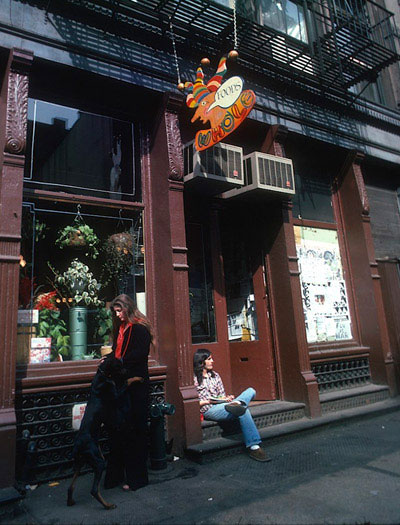
“I had never heard of SoHo… And when I went there, it looked like a slum area, papers flying all over the street,” says Charles Rosenblum, remembering his first visit to 117 Prince Street in 1978. Rosenblum, a lapsed pharmacist from the Bronx whose herb and ginseng distribution business brought him to SoHo, had no idea then that he would spend the next 20+ years as proprietor of Whole Foods (no relation to the supermarket chain), one of the only grocery stores in SoHo, and a vanguard in the burgeoning organic food movement that would surge across the U.S. in the 2000s.
To back up a bit, Rosenblum had health and retail in his blood. His father was a pharmacist, so he became a pharmacist. His grandparents were “delicatessen people.” After owning a successful pharmacy in Harlem for a number of years, he moved on to herb distribution, but found that it wasn’t such a lucrative field, so he started thinking about going back into retail. One of his wholesale clients was a struggling health food store in the middle of nowhere:
…I really wasn’t making any serious money in this distributing business. I knew a little about the health food industry because I had gone to health food conventions selling my ginseng products, and I started thinking about going back into retail. And lo and behold, one Sunday in The New York Times, there was a food store for sale. And I thought, before I saw it, I said, oh God, I hope it isn’t that store in SoHo because it’s such a desolate, isolated area. And sure enough, it was. … And I thought, oh boy, what a lousy location. Except I noticed that they had this place, Dean & DeLuca next door, which seemed to be rather busy.
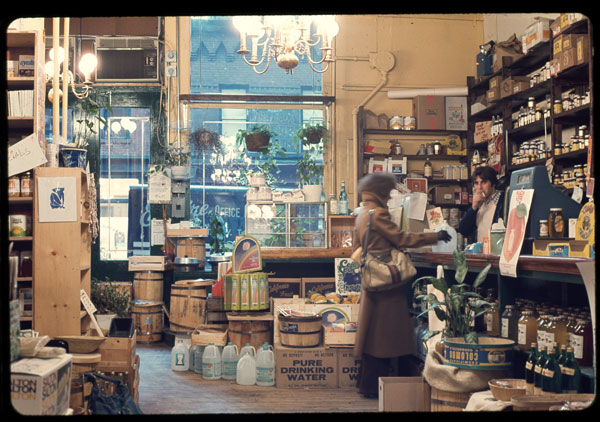
After hanging around the struggling store and even volunteering as a worker, Rosenblum bought it and secured a new 10-year lease from the landlords, Charles Leslie and Fritz Lohman, who owned quite a few buildings on Prince Street and would later go on to open the Leslie-Lohman Museum of Art on Wooster Street. Roseblum named the store Whole Foods and stocked only organic items back when only a sprinkling of people in New York City knew what that meant.
When I started it, it was desolate. … but fortunately, being a food store, people did shop the store late. And so I ended up closing about 10 o’clock at night because we were so busy.
I was very fortunate that my retail skills came together, if you will, …with my concerns about health. I was a little leery about pharmacy and drugs and doctors and medicine. So it was an easy transition for me to go from being a pharmacist, to being this proprietor of a health food store. It was almost like the other side of a coin, but it still had the same concept of trying to help people get healthier and that, well, that was what the health food store was about.
People would come to me from different areas of the city to buy esoteric things like duck eggs or organic millet or some grain that they weren’t able to get. And Dean & DeLuca was thriving next door. They would get some of my walk-in customers, and I’d get some of theirs. So it worked out just fine.

And then there were the organic turkeys:
We had organic turkeys. That was special. Not everybody had organic turkeys, but there was a Mennonite farm in Lancaster that would deliver the day before Thanksgiving, 60 or 70 turkeys. …And we would take all these orders and then the turkeys would just come haphazardly. They weren’t what we had asked for. So somebody who wanted a 12 pound turkey for a family of just a couple of people, they had to take a 20 pound turkey, because that’s all we had left when they came to pick up their turkeys. And the people who wanted a 20-pound turkey, if we didn’t have those, they had to get two 12-pound turkeys. Anyway, everybody sort of rolled with it. They were very understanding. Everybody was laid back.
Of course, it helped to get a New York Times bump now and again:
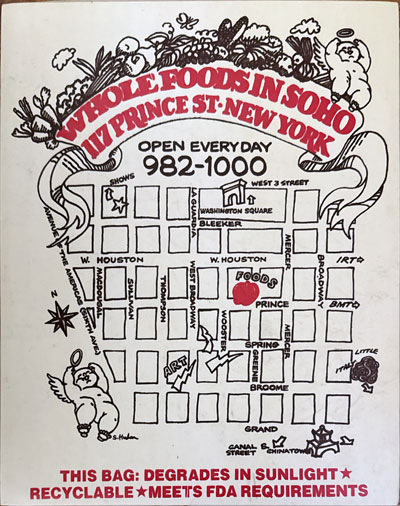
So we had a very good niche in the health food world. We would have people like Florence Fabricant who would be writing for Thursday’s food column for The New York Times. Florence would sometimes mention Whole Foods for whatever reason. Usually it was good. And every time The Times mentioned Whole Foods, it meant more customers. But people didn’t know where SoHo was. So I had shopping bags made with maps of SoHo on it.
When asked about his clientele, Rosenblum smiled:
It was a great community. Everybody was very supportive of each other. They were all either dancers or creative people in some way. They were writers, playwrights. I got to know them. And some of them I started bartering with. They didn’t have very much money. These were young, struggling artists, and they would say, look, why don’t you buy a painting from me? And you can pay me back in food. So that worked out. Unfortunately, I didn’t do as much bartering as I should have in retrospect, because I had Keith Haring as a customer, I had Basquiat as a customer.
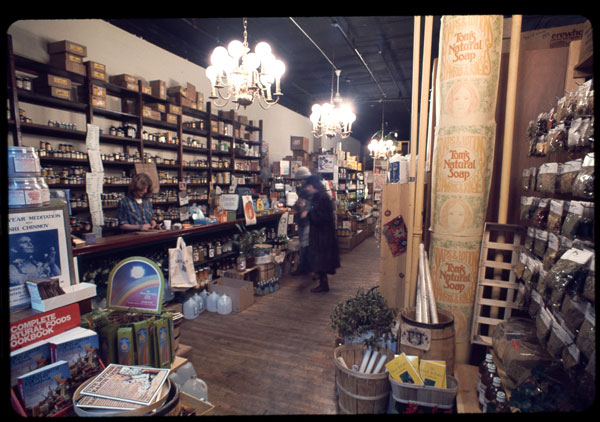
I asked Rosenblum why he ended up closing when he did, in 2000. Apparently, it was time, and he also had a prepared foods section of his store with very good but aromatic chicken:
Our takeout food business became very popular because we also had organic food at our salad bars. Even our chicken at the salad bar was organic. And that got me into trouble with the neighbors upstairs because those chicken smells would go up there. …The chicken smells just went on and on.
It was one of the reasons why they didn’t want to give me a new lease after I had been there 20 years. The residents of that co-op had asked Fritz and Charles, the landlords, please don’t rent this to a food store anymore. There’s too much garbage outside. And since SoHo was now a very hot area for retail, it was no problem for them to get a new tenant. And unfortunately, that was the reason why we closed….
But I was also a bit tired of retail. It wore me out. I was approaching my late-sixties. When you’re in retail, every day is a problem. And I was tired of it…I had some real special times, some really good times there. It was just such a wonderful opportunity for me to meet great people, great artists. And I was very happy working in SoHo.
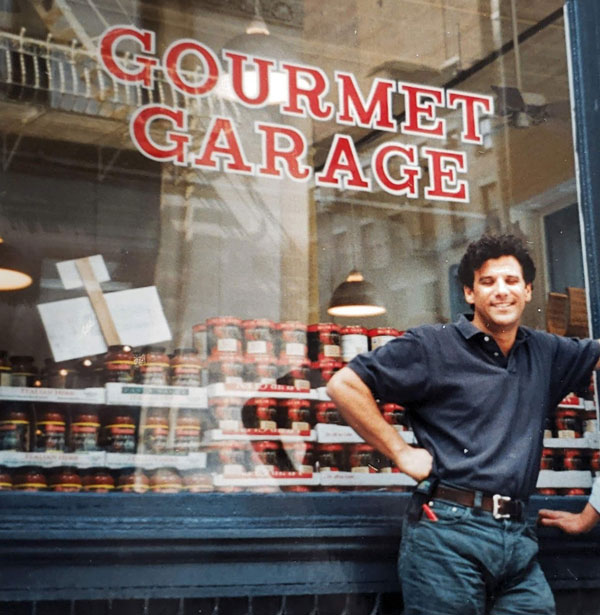
By the time Whole Foods closed, a different kind of food store had been open in SoHo for almost a decade just a few blocks away. Also a vanguard in fresh produce and quality prepared foods, Andy Arons and his partners opened Gourmet Garage in 1992 on Wooster near Broome Street in a former garage that itself was a former stable. Having worked in restaurants throughout college, Arons and his college roommate began working for a small specialty foods importing company that quickly went out of business. Arons remembers:
But Walter, my roommate, and I knew where the suppliers were and we were getting such a great reaction from all these chefs, the great chefs of that era, Andre Soltner at Lutece, Jean-Jacques Rachou at La Côte Basque, Le Cirque, Tavern on the Green, all these sort of eighties era restaurants. ‘81 is when I got here. We started bringing these products in. Fresh Dover sole, haricots verts, fresh truffles, mushrooms. And most of these guys hadn’t seen those products since they left Europe. And we were getting this incredible experience supplying these people. So we started a company on our own called Flying Foods International.
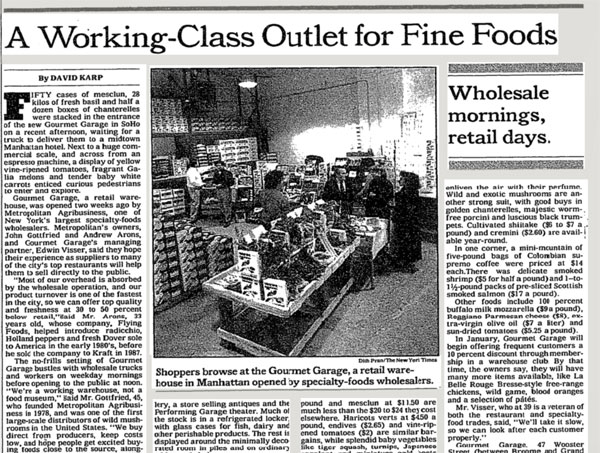
Arons took on Raoul’s (a French restaurant on Prince Street) as one of his first clients and discovered SoHo. Fast forward, Arons sells Flying Foods to Kraft Foods and then later goes on to open another food distribution company, first on Thompson Street, and then in 1991 in a garage space on Wooster:
I had the idea of opening the warehouse doors to the public on the weekend, and then we would open up every day. So we’d kind of supply the chefs in the morning and open these warehouse doors in the afternoons at 11, and roll out a couple of cash registers on a little trolley and we had a couple of cashiers and people could come in and buy the same products these great chefs were buying.
And we really wanted to target SoHo because…you had artists and some actors and some professors, people at a high taste level, but who maybe didn’t have the pocketbook to afford Dean & DeLuca prices back then. So that was the idea. It was sort of like Costco meets Dean & DeLuca. We called it Gourmet Garage.
Gourmet Garage quickly outgrew its garage and moved just two blocks east in 1993:
So we had that little one to start, and we kept the wholesale division going for a while, and soon we found that people were just loving the retail side. So we expanded it. That’s when we moved to Mercer and Broome into that corner space….And we had that for about 20 years, and that was a blast. I mean, we really expanded our offerings. We had fresh bread. Eli came down, and Jim Lahey from Sullivan Street Bakery. I hired a former chef that was a friend of mine that I met in Paris, but he was a chef at Le Cirque and Tavern on the Green, and he had a Michelin star in France, and we were doing these great prepared foods. Americanized, Frenchy, everything, a mishmash of stuff. It was really, really good stuff. And we were pricing it well.
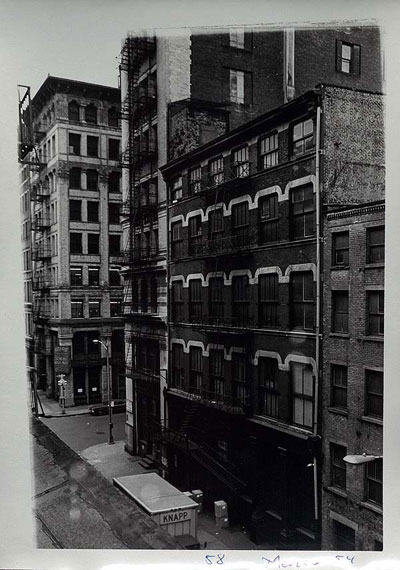
Arons remembers looking out at the rundown cast iron buildings when they first opened, thinking about what came before:
It was a really funny thing to look at every day, just to think of how many generations of people that lived down here. I remember reading Caleb Carr’s The Alienist. They’re chasing the bad guy in a horse-drawn hansom cab that rounds Broome Street and Mercer. Pretty cool.
As the neighborhood changed, the buildings got cleaned up and their clientele diversified:
In the early eighties [our customers were from] the local creative class that was living down there. And the stores were much smaller and we had a different product mix. We started loading it up as the buildings converted to a blend of residential and commercial businesses. …Second floor lofts and up became architectural offices and printing places and design spaces. That was a really great combo for us. Residential mixed with commercial offices. So that was the change. We saw a lot of cool business types.
And we started doing really huge lunches. When we started, we were a little bit more of a grocery store, and as that started ramping up, we just started doing bigger and bigger lunches.
So we went from having four soups to eight soups to 12 soups to 14 soups every day. And they would sell out twice. People were waiting in line for soup! I mean, it was really, really fun. There wasn’t a lot of choice back then.
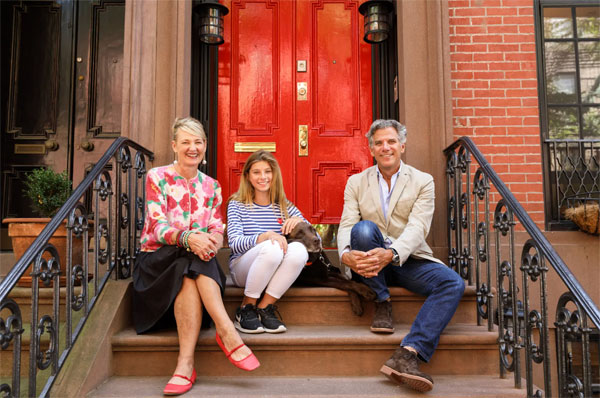
(photo: Robert Wright for The New York Times)
Arons had loads of fun growing his business back in those Mercer Street days, and with a little help from his produce section, he also grew his family. Elyce, Arons’ now wife, opened the first Kate Spade store on the other side of Broome Street and Mercer, with her college roommate and the store’s namesake, Kate Spade.
We had this one unbelievable nectarine and peach supplier from the west coast. So rather than flowers, I would send [Elyce] a whole case of these nectarines. I knew they were so unbelievably good and she’d be giving them out and all the people in her office would see how great I was. That was like 25 years ago. So it really worked!
In 2010, Gourmet Garage relocated again, this time to Broome Street between West Broadway and Wooster:
We had that giant 5,000 square foot space [on Mercer and Broome], and then the whole basement where we built a kitchen. The rent there was like $4,000 when we started. It went up to $50,000 when we left. So we left.
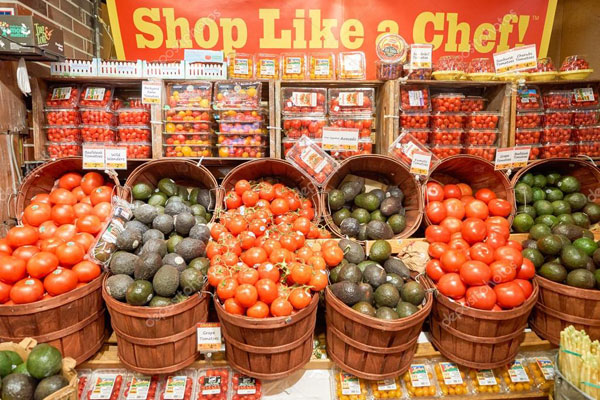
In 2019, Arons and his partners sold Gourmet Garage to ShopRite, who kept the SoHo store open until the lease ran out just last year, and their four other stores are still going strong. For three decades, Gourmet Garage helped SoHo residents and tourists alike shop like chefs, but it came time to move on:
[Competition] was really heating up and we just saw the writing on the wall and we’d been doing it a long time. I’m not as young as I used to be, and my partner and I, we could have kept it going on fumes for a long time, but there’s so much competition. Trader Joe’s is owned by this company called Aldi, which is the Walmart of Germany. So it’s impossible to compete with someone that’s selling stuff for half the price than you can sell it for…
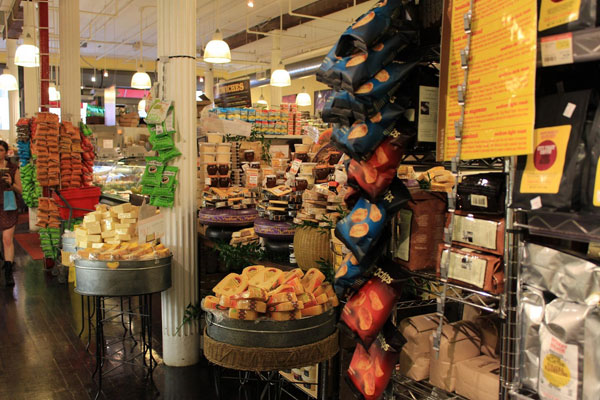
Nevertheless, Arons looks back on his SoHo years very fondly, especially the people he met along his retail journey:
We had people that stuck around for a really long time and I really miss them. And I miss the interaction they had with our customers… When I was a kid, we grew up outside of Boston. The lady at the bakery knew us and would always give my brother and I these special little elephant ears when we went in.
And it was the same way for us. …I saw this woman, I just knew she was one of our customers. I said, “I remember you, you were the beautiful woman that always would come in with her little daughter.” And she said, “No, I’m the little daughter!” And she was probably 50-something. We had so many good experiences. Every day was like a dream. I just loved hanging out there. We ended up having a lot of stores and [SoHo] was always my favorite.
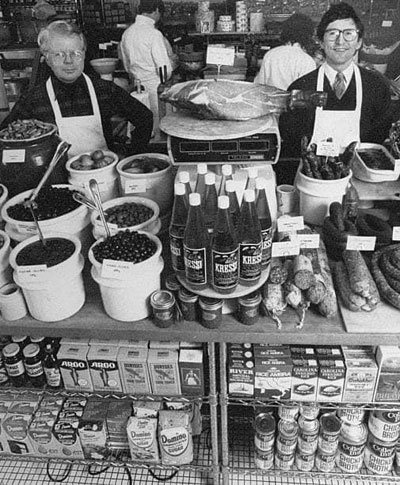
For Andy Arons, and for Charles Rosenblum, when you ask them what they miss most about their time in SoHo, they say it’s the people. I wonder if Joel Dean and Giorogio DeLuca would say the same. Probably. It’s nice to know that, at one time, there was a direct connection between seller and buyer, owner and customer, person and person. When the person at the top has a personal stake in the person buying a tomato from them at the other end, a stake in whether the store is clean and well-stocked and the personnel friendly and caring, a community forms around these spaces and adds joy to everyone’s everyday.
Nowadays, much more often than not, the people at the top are somewhere far away and the people buying the tomatoes, or the yoga pants, or the sofa, are data points. They’re not the beautiful woman with her daughter, or Jean-Michel Basquiat buying his morning shot of wheatgrass after a long night of partying. They can’t barter for food, nor can they name the person who baked their focaccia.
Of course, things always continue to change and you can’t stand in the way of progress and all that. But when community is lost while getting from point A to point Z, one must stop and reflect on the high cost of doing business.
(featured image: Drawing of Gourmet Garage by Lee Erickson)