
Judging from the reactions to my Instagram posts about old old SoHo, meaning pre-twentieth-century SoHo, I think folks have a keen interest in not just when our neighborhood was an artists’ community, but what was here even before industry arrived in the late-nineteenth century.
In the mid-1800’s, the stretch of Broadway between Canal and Houston Streets was a center of opulence that would put its current day incarnation to shame. The Broadway “corridor,” as it is now called, was then the stomping ground of the well to do. Our neighborhood’s long history, from meadowland to suburb to commercial center to red light district to industrial hub to art capital and back to commercial center, reminds us that our city is forever changing.
It’s fascinating to see what SoHo streets looked like before Chanel and Gucci, before lofts and galleries, even before cars and street lights. Let’s take a look back, and some of what we see promises to be surprising!
Canal Street
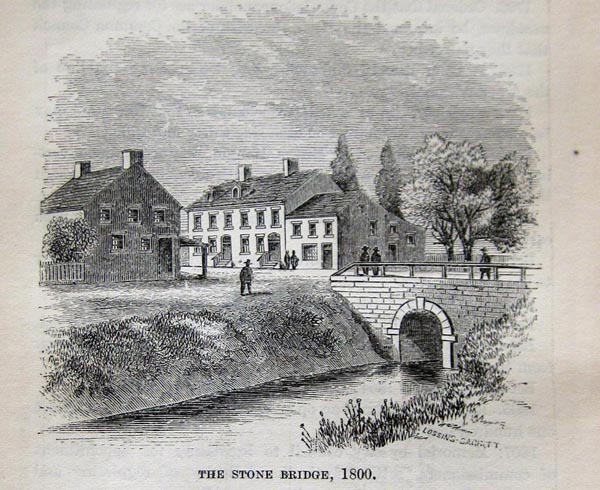
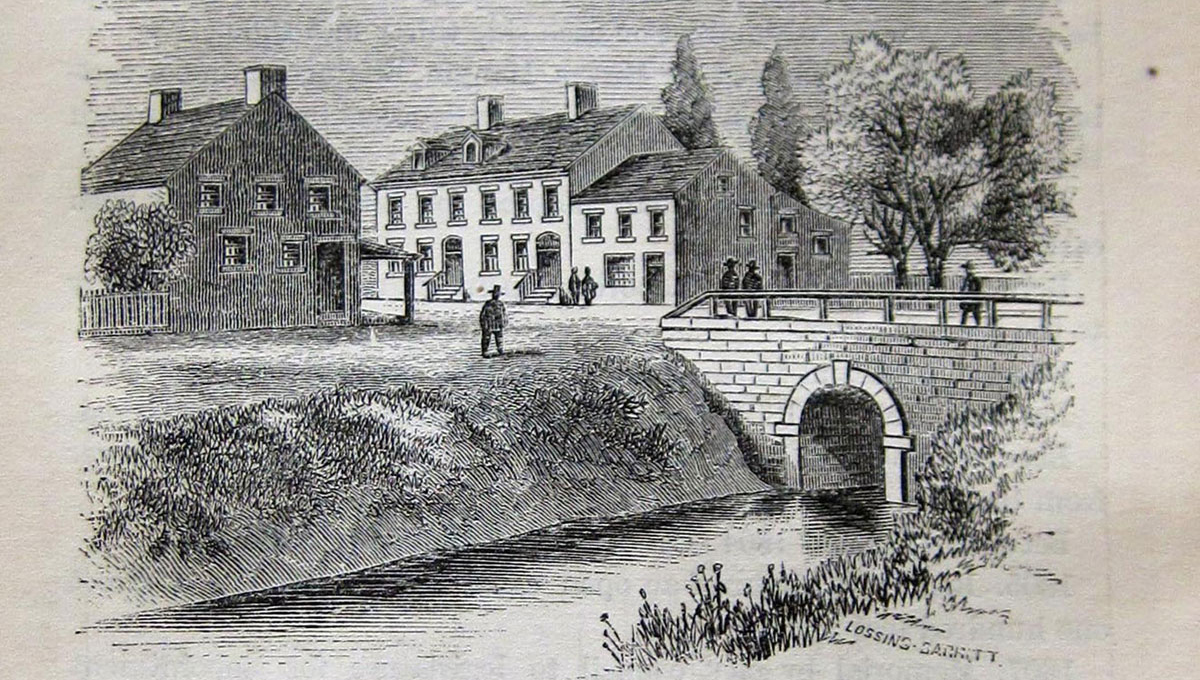
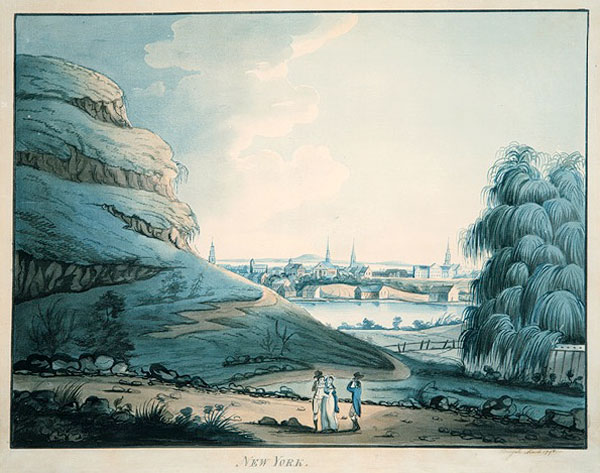
Believe it or not, Canal Street was not only once an actual canal, but it was also the northernmost border of New York City. In the early-1800’s, an old stone bridge straddled the border between city and country on Broadway. The land south of the bridge was “the city,” where people lived and worked. Collect Pond, a fresh water reservoir that provided drinking water to citydwellers north of current-day City Hall, fed into the canal that gave Canal Street its name, which in turn emptied out into the Hudson River.
Walker Bicker shares his memories of the bridge and its environs in the early 19th century for the Aprll 9, 1886 issue of The New York Times:
Broadway was not paved beyond “the stone bridge” which stood where Canal-street now crosses Broadway. This was a famous resort for us schoolboys. It was considered “out of town”—all north beyond as well as the immediate vicinity was country, post and rail fences dividing the land into different sized parcels. This bridge spanned a small stream which conveyed water from the Collect on the east side of Broadway (where now stands the Tombs) to the west side, where was an extensive meadow covering most of the ground from Broadway to the north River and from Lispenard-street to Spring-street.
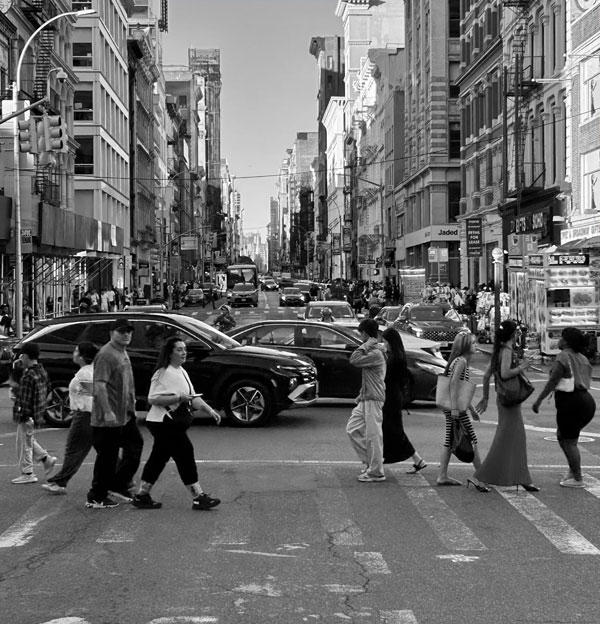
Nowadays, the stream is made of pedestrians, thousands of them crossing the former line between town and county to reach parcels of land inhabited by Zara, H&M, and Ikea!
The Haughwout Building
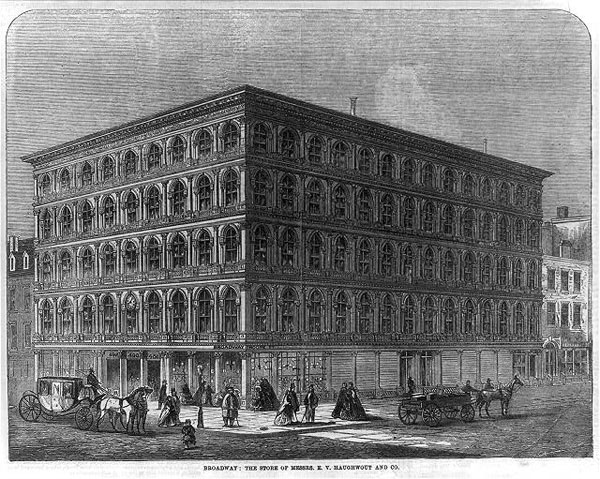
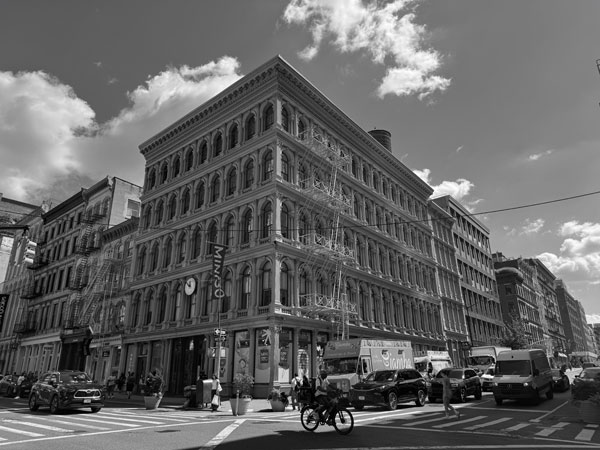
By the mid-1800’s, Broadway between Canal and Houston Streets developed into a stomping ground for the well to do and was home to luxury stores such as Lord and Taylor and Tiffany’s. In its day, one of the most well-known stores along this stretch was the opulent Haughwout Emporium at 488 Broadway at the southeast corner of Broome Street.
Built in 1857, the Haughwout Building, which is modeled on a 16th-century Venetian library, is one of the finest examples of cast iron architecture in New York City and was originally the home of the Haughwout Emporium, owned by Eder V. Haughwout, manufacturer and purveyor of fine china, cut glass, silverware and chandelier. His business attracted many high profile clients, including Mary Todd Lincoln, who had her official White House china made there. Other customers included the Czar of Russia and the Imam of Muscat.
The building’s other claim to fame is that Elisha Graves Otis designed and installed his first commercial hydraulic elevator in the building (for a whopping $300!). The elevator moved at 40 feet per minute and had an automatic safety brake to prevent it from free falling. Visitors would come to see the elevator and then stay to shop for china and silver. A clever marketing device indeed.
Today, Mino So, a store that sells plushies, blind boxes, anime figures, and capsule toys, as well as exclusive merchandise featuring popular franchises like Sanrio, Disney, Pokémon, Harry Potter, Care Bears, and The Powerpuff Girls. I doubt that Melania is planning to pay a visit, but you never know!
The St. Nicholas Hotel
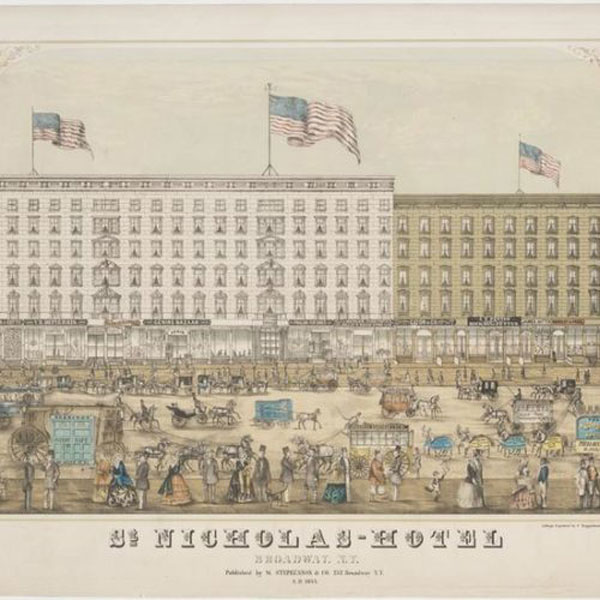
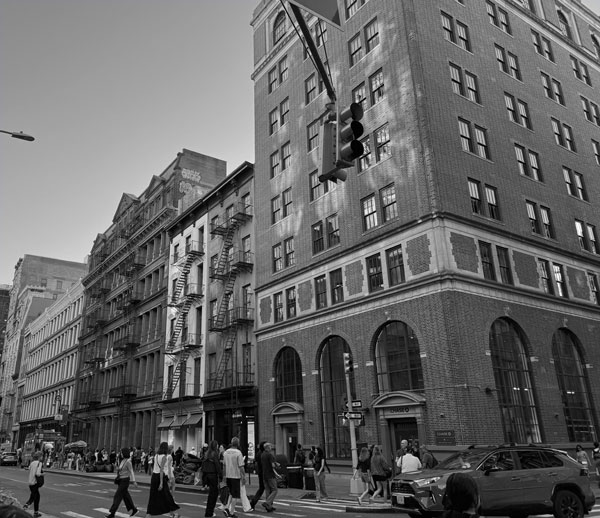
Across the street, on the west side of Broadway between Spring and Broome Streets, The St. Nicholas Hotel was a hotel like nothing New York City had seen before. It was said to have ended the reign of the Astor House, on Broadway at Vesey Street, as the preeminent New York hotel.
Opened on January 6, 1853, The New York Times reported that “[t]his magnificent establishment, which in extent of accommodation, completeness of arrangement, costliness and chaste elegance of decoration, and combination of all modern improvements, takes place as the Hotel par excellence of our day.”
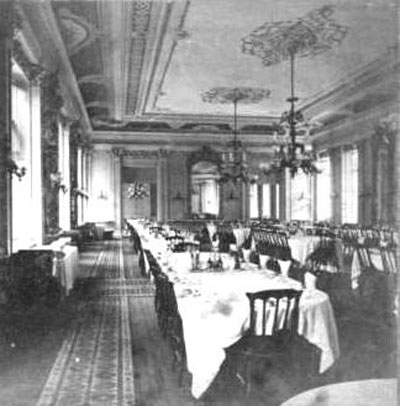
When it first opened, the St. Nicholas stretched from Broome Street 100 feet toward Spring Street, and within a year the hotel was extended to the end of the block. The six-story building was of Italian architecture with Corinthian elements. Touting a marble lobby with frescoed ceiling, the St. Nicholas was the first building in New York City to cost over $1 million to build (and cost another $700,000 to furnish). Accommodating over 1,000 guests per week, it had several dining rooms, a reading room illuminated by an ornate, an elaborate men’s hair-cutting salon with gilded domed skylight, a gentlemen’s drawing room, among other amenities.
This block has traded drawing rooms for fitting rooms, and is now home Levi’s, Brandy Melville, Zara, H&M, among other stores.
Tiffany & Co.
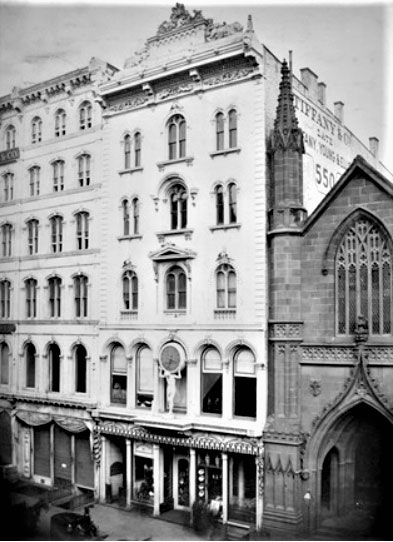
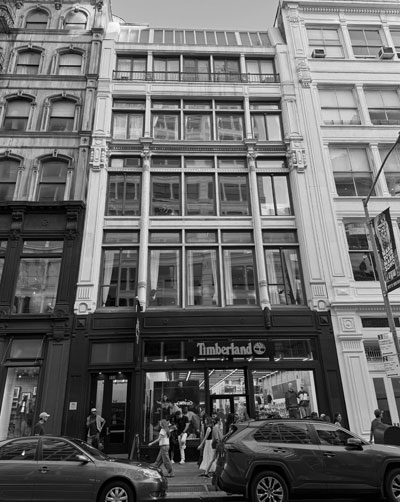
Just across the street from the St. Nicholas, Tiffany & Co. opened at 550 Broadway in 1853.
Tiffany & Co.’s story actually began on Broadway in 1837, when Charles Lewis Tiffany and John B. Young opened a small “stationery and fancy goods” store at 259 Broadway, near Warren Street. Originally known as Tiffany & Young, the shop sold stationery, decorative objects, glassware, and porcelain. As the business grew, it moved up Broadway to larger quarters at 271 Broadway in 1847, and then to 550 Broadway in 1853. That same year, Charles Lewis Tiffany took full control of the company, renamed it Tiffany & Co., and began sharpening its focus on fine jewelry and luxury goods. Those early Broadway addresses trace Tiffany’s transformation from a modest fancy-goods shop into the foundation of one of America’s most celebrated luxury houses.
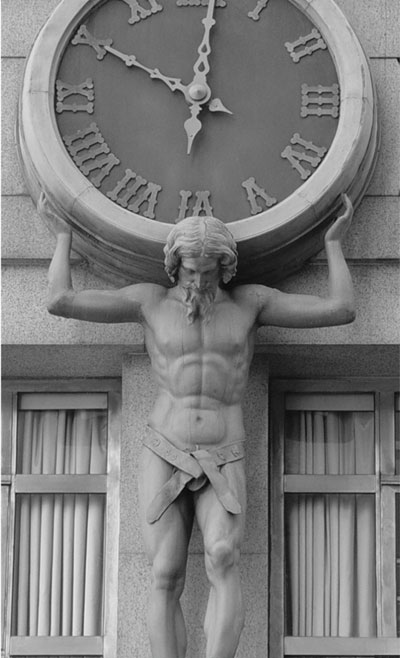
The building originally featured an Italianate white marble facade, but converted to cast-iron later on. Charles Tiffany added a 9-foot wooden and bronze statue of the Greek god Atlas holding a 4-foot clock above the entrance to the store because he felt that the front of the building looked too plain, and the clock gave customers a landmark. The iconic Atlas clock traveled with the company through later moves and now stands above the main entrance at the Fifth Avenue flagship store.
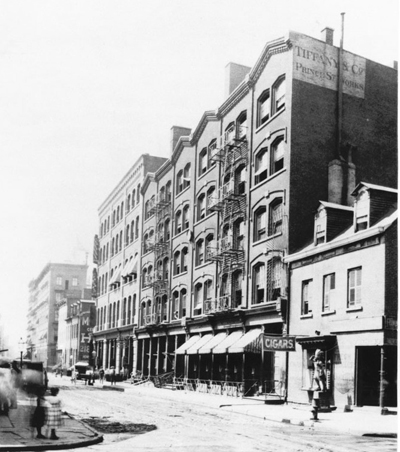
As a side note, around the corner the brick building at 53-55 Prince Street is the surviving portion of Prince Street Works, the silver department of Tiffany & Co. Some of the most influential American silver was designed in this building, which was used by Tiffany until 1897.
Today, Tiffany & Co. is back in SoHo, this time at 97 Greene Street, sans clock.
Barnum’s American Museum
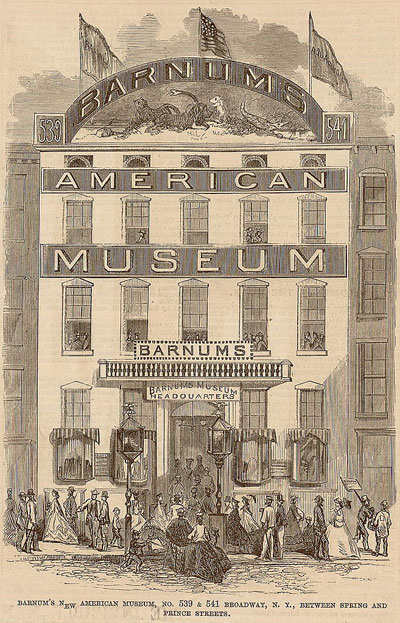
Just up the street from Tiffany’s and the Metropolitan, a familiar name not often associated with SoHo set up shop. Long before P.T. Barnum founded his famous three-ring circus, he opened an “instructive entertainment” venue called Barnum’s American Museum in 1842 on Broadway at Ann Street.
Eric Grundhauser describes the museum on Atlas Obscura:
Inspired by Barnum’s love of both spectacle and knowledge, the American Museum became a wild mish-mash of exhibits that included live animals, an elegant lecture hall that hosted grand theater and luminaries, and the country’s first aquarium, which held a white whale in water pumped in from the East River. There were even human attractions such as famed conjoined twins Chang and Eng, a bearded lady, and “General Tom Thumb,” a dwarf who became one of Barnum’s lifelong friends.
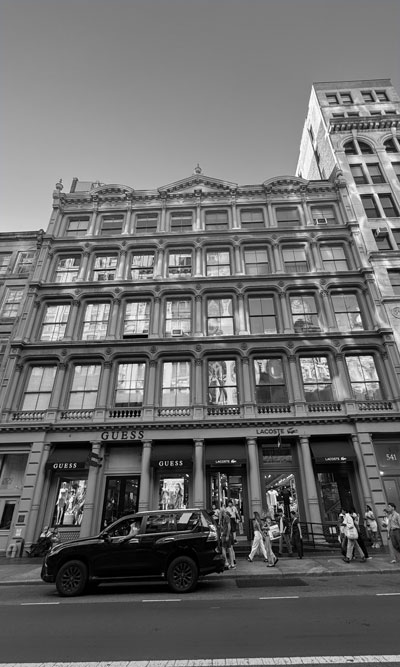
The museum was a huge success and remained so until it burned to the ground in 1865. Ever the optimist, Barnum reopened his museum, this time at 539-541 Broadway between Prince and Spring streets
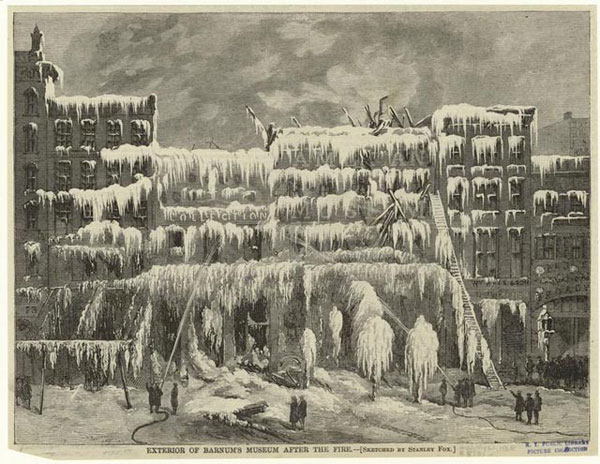
Unfortunately, the third version of the museum was also doomed, as disaster struck once again. The building caught fire at midnight on March 3, 1868, and the freezing weather caused the water being used to fight the fire to freeze, leaving another unexpected spectacle. The entire building was covered in ice. This time, Barnum felt defeated and decided to get out of the museum business. He turned his attention to politics before he began his famed circus.
In the early 20th century, the building housed many factories including M.M. Bernstein & Co., manufacturers of corset covers, Sol Edman & Sons who made shirts, and rubber stamp producer S. Buck Manufacturing Company. In the early 1980’s, when most of the factories had moved out, the building was (and still is) occupied by many dancers and artists, and is also home to Guess and Lacoste.
Niblo’s Garden
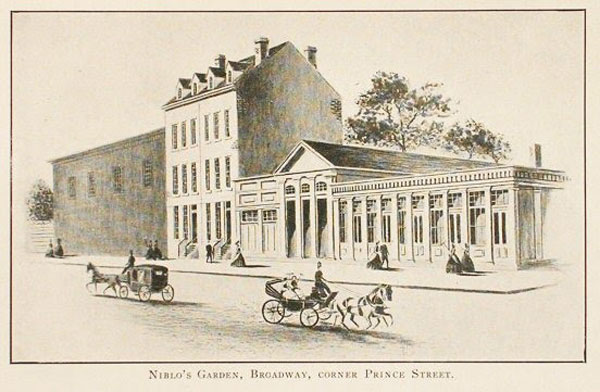
After being wowed at Barnum’s, one needed only to venture north half a block to Niblo’s Garden, one of New York City’s premier “pleasure gardens,” to find diversion and amusement, both indoors and out. Niblo’s was located at the corner of Broadway and Prince Street and extended all the way to Crosby Street to the east and Houston Street to the north. In addition to gardens, an open-air saloon, and an exhibition hall, in its heyday Niblo’s housed a 3,200-seat theater at which The Black Crook, considered to be the first piece of American musical theatre, was performed, and at which P.T. Barnum made his show business debut.
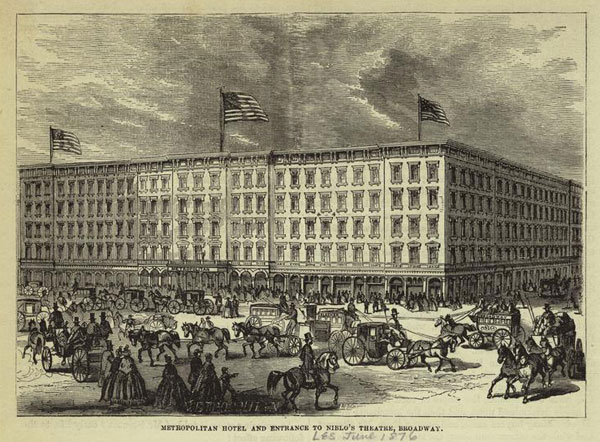
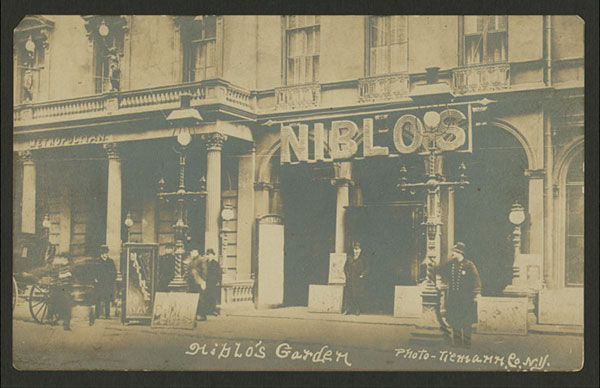
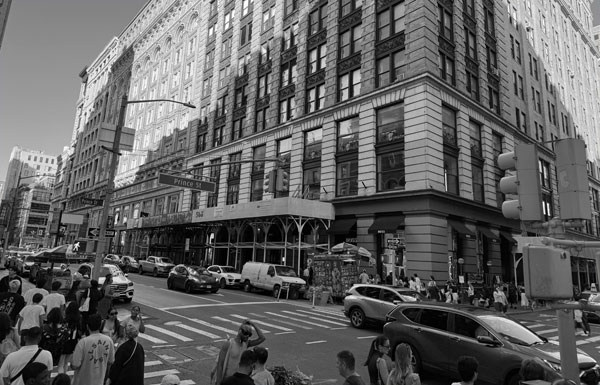
In the early 1850’s the Niblo’s theater was integrated into The Metropolitan Hotel, one of the most opulent hotels of the era, which was built on the site at a time of a “hotel boom” in response to the opening of the New York Crystal Palace exhibition of 1853. In the 1870’s the hotel was managed by Richard Tweed, son of the infamous Boss Tweed. By 1895, The Metropolitan Hotel was demolished to make way for the Havemeyer Building built by sugar magnate Henry O. Havemeyer as a sewing factory and is the building we see today at the northeast corner of Prince and Broadway.
SoHo Yesterday Today Tomorrow
The SoHo Memory Project largely focuses on preserving the history of SoHo in the latter half of the 20th century, when the area was a thriving artists’ community. But there was a thriving SoHo before SoHo was SoHo, and there is also a thriving SoHo today. We live in a city fueled by change. Each new iteration of our neighborhood is a reaction to what came before, and well a sign of the times.
Rural farmland transitioned to a suburb and then a commercial and residential neighborhood as the population of old New York grew. Industry moved in after property values declined as shopping, dining, and entertainment centers moved further north toward Union Square and beyond. Artists moved in when industry moved out of New York in search of larger, horizontal spaces with room for larger machines and longer trucks. Luxury boutiques and lofts came about due to artist-led gentrification, a known phenomenon aptly named the “SoHo Effect.”
And here we are today. SoHo will change again, it is always changing. Have you ever wondered what its next incarnation will be? What will have replaced Prada and The Mercer Hotel on our block when our 18-year-old daughter is my age? I wish I could tell you, but all I know is that 50 years from now, maybe Fanelli’s will still be on the corner, but the rest of it is very TBD.
Content in this story originally appeared in my column,”A Look Back,” that appeared on the SoHo Broadway Initiative website from 2015-2019.